
Syringe Pump vs Peristaltic Pump: Which One Does Your Lab Need?
Syringe Pump vs Peristaltic Pump:
Which One Does Your Lab Need?
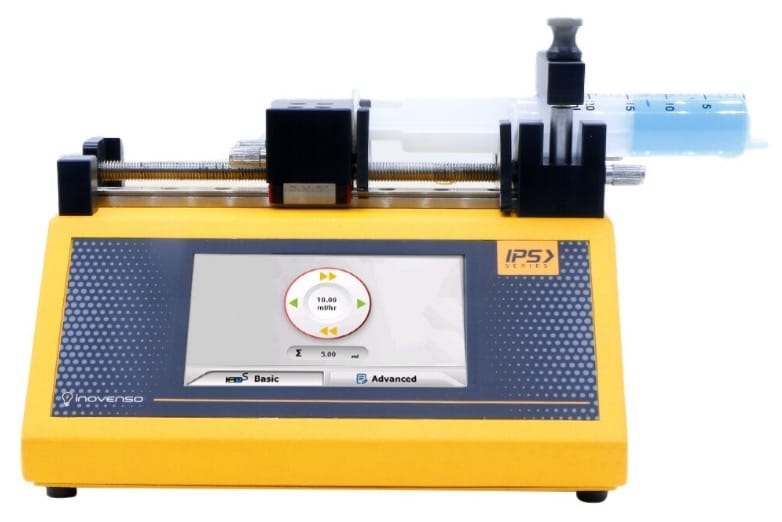

Choosing between a syringe pump and a peristaltic pump is one of the first decisions a lab faces when setting up a fluid delivery system. Both move liquid precisely — but they do it differently, and that difference matters enormously depending on what your protocol demands.
This guide breaks down how each pump type works, where each excels, and how to decide which one belongs on your bench.
How a Syringe Pump Works
A syringe pump drives a syringe plunger forward (infusion) or backward (withdrawal) using a stepper motor and lead screw mechanism. The motor turns in precise microsteps — on Inovenso IPS Series pumps, each microstep moves the plunger exactly 357 nanometers — translating directly into an extraordinarily accurate and pulse-free flow rate.
Because the volume inside a syringe is fixed and the displacement per step is known, flow rate is determined purely by the speed of the motor. There are no valves, no rollers, and no tubing to wear out. The result: very low flow rates (down to 17.89 pL/min on a 0.5 µL Hamilton syringe) with exceptional reproducibility.
Key principle: A syringe pump is a displacement pump. Volume is known, steps are countable, and flow rate is calculated — not estimated. This makes it inherently more accurate at low flow rates than any other pump type.
How a Peristaltic Pump Works
A peristaltic pump squeezes flexible tubing between rotating rollers and a pump housing. As the rollers advance, they trap and push fluid forward in a wave-like motion. The fluid never contacts the pump mechanism itself — only the tubing does.
Flow rate is controlled by varying the motor speed (RPM). The IPS-20 runs from 1 to 600 RPM; the IPS-21 from 0.1 to 100 RPM with finer resolution. Maximum flow rate depends on tubing diameter and can reach 2280 mL/min — far beyond any syringe pump.
Side-by-Side Comparison
| Parameter | Syringe Pump | Peristaltic Pump |
|---|---|---|
| Flow principle | Displacement (plunger) | Peristalsis (roller compression) |
| Min flow rate | 17.89 pL/min | ~µL/min range |
| Max flow rate | ~121 mL/min | 2280 mL/min |
| Flow continuity | Finite (syringe capacity) | Continuous |
| Sample contact | Syringe + tubing | Tubing only |
| Pulsation | Virtually none | Slight (inherent) |
| Accuracy at low flow | Excellent | Good |
| Sterile applications | Possible (sterile syringe) | Ideal (tubing only) |
| Refilling required | Yes (syringe capacity) | No |
| Typical use | Research, microfluidics, MS | Bioprocessing, industrial |
When to Choose a Syringe Pump
- Flow rates below 1 mL/min are required
- Pulse-free flow is critical (MS, microfluidics)
- Precise volume delivery matters more than continuous flow
- Running electrospinning, electrospraying, or co-axial setups
- Protocol requires infusion and withdrawal in sequence
- Working with expensive or hazardous small-volume samples
- High-volume continuous flow is needed (>100 mL/min)
- Sample must never contact the pump mechanism
- Sterile or contamination-sensitive fluids are involved
- Running 24/7 processes without interruption
- Aggressive solvents, acids, or corrosive fluids are used
- Bioprocessing, pharmaceutical fill-finish, or food handling
The Flow Rate Overlap Zone
There is a range — roughly 1 mL/min to 120 mL/min — where both pump types can technically perform. In this zone, the deciding factor shifts to pulsation tolerance, sample contamination risk, and whether continuous or finite flow is required.
If your mass spectrometer or microfluidic chip is sensitive to even minor pressure oscillations, a syringe pump wins. If your bioreactor needs to run overnight without someone swapping syringes, a peristaltic pump wins.
Practical tip: Many labs run both. A syringe pump handles precise low-flow delivery during experiments; a peristaltic pump handles buffer transfer, washing steps, and media preparation. The IPS Series covers both needs on the same platform.
Explore the Full IPS Pump Range
Syringe pumps, peristaltic pumps, Wi-Fi models — compare all specifications side by side.
