Choosing between a syringe pump and a peristaltic pump is one of the first decisions a lab faces when setting up a fluid delivery system. Both move liquid precisely — but they do it differently, and that difference matters enormously depending on what your protocol demands.
This guide breaks down how each pump type works, where each excels, and how to decide which one belongs on your bench.
How a Syringe Pump Works
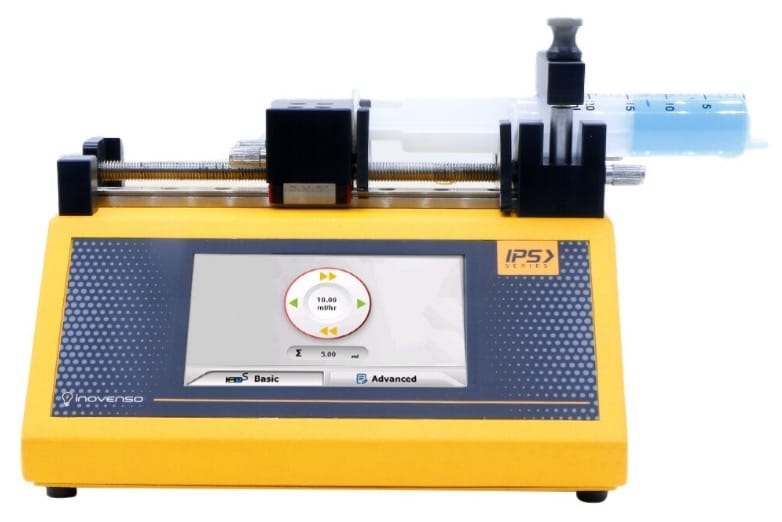
A syringe pump drives a syringe plunger forward (infusion) or backward (withdrawal) using a stepper motor and lead screw mechanism. The motor turns in precise microsteps — on Inovenso IPS Series pumps, each microstep moves the plunger exactly 357 nanometers — translating directly into an extraordinarily accurate and pulse-free flow rate.
Because the volume inside a syringe is fixed and the displacement per step is known, flow rate is determined purely by the speed of the motor. There are no valves, no rollers, and no tubing to wear out. The result: very low flow rates (down to 17.89 pL/min on a 0.5 µL Hamilton syringe) with exceptional reproducibility.
Key principle: A syringe pump is a displacement pump. Volume is known, steps are countable, and flow rate is calculated — not estimated. This makes it inherently more accurate at low flow rates than any other pump type.
REF
Syringe pump flow accuracy in microfluidics: Programmed syringe pump flow rate and measured flow rate (via liquid flow meter) were effectively identical over the 1–7 µL/min range (R² = 0.9999) — demonstrating that syringe pumps are the reference standard for low-flow microfluidic applications. Peristaltic pumps achieved comparable linearity (R² = 0.9971) in the same range but with inherently higher pulsation. —
Utility of Low-Cost, Miniaturized Peristaltic and Venturi Pumps in Droplet Microfluidics, PMC / Analytica Chimica Acta, 2021.
pmc.ncbi.nlm.nih.gov/articles/PMC7897340/
How a Peristaltic Pump Works
A peristaltic pump squeezes flexible tubing between rotating rollers and a pump housing. As the rollers advance, they trap and push fluid forward in a wave-like motion. The fluid never contacts the pump mechanism itself — only the tubing does.
Flow rate is controlled by varying the motor speed (RPM). The IPS-20 runs from 1 to 600 RPM; the IPS-21 from 0.1 to 100 RPM with finer resolution. Maximum flow rate depends on tubing diameter and can reach 2280 mL/min — far beyond any syringe pump.
REF
Peristaltic pump pulsation at low flow: Peristaltic pumps offer less long-term flow stability than syringe pumps and require recurrent calibration. The pulsation issue at low flow rates is approximately ten times higher in peristaltic pumps compared to syringe pumps, making them less suitable for precision low-flow applications. —
Syringe pumps and microfluidics, Elveflow Microfluidics Review, 2025.
elveflow.com/microfluidic-reviews/syringe-pumps-and-microfluidics/
Side-by-Side Comparison
| Parameter |
Syringe Pump |
Peristaltic Pump |
| Flow principle |
Displacement (plunger) |
Peristalsis (roller compression) |
| Min flow rate |
17.89 pL/min |
~µL/min range |
| Max flow rate |
~121 mL/min |
2280 mL/min |
| Flow continuity |
Finite (syringe capacity) |
Continuous, indefinite |
| Sample contact |
Syringe + tubing |
Tubing only |
| Pulsation |
Virtually none |
Inherent (dampeners help) |
| Accuracy at low flow |
Excellent (R²≈1.000) |
Good (R²≈0.997) |
| Sterile applications |
Possible (sterile syringe) |
Ideal (tubing swap) |
| Tubing wear |
None |
Requires periodic replacement |
| Refilling required |
Yes (syringe volume) |
No |
| Typical use |
Research, microfluidics, MS, electrospinning |
Bioprocessing, perfusion, industrial |
When to Choose a Syringe Pump
Choose Syringe Pump When…
- Flow rates below 1 mL/min are required
- Pulse-free flow is critical (MS, microfluidics, organ-on-chip)
- Precise volume delivery matters more than continuous flow
- Running electrospinning, electrospraying, or co-axial setups
- Protocol requires infusion and withdrawal in sequence
- Working with expensive or hazardous small-volume samples
Choose Peristaltic Pump When…
- High-volume continuous flow is needed (>100 mL/min)
- Sample must never contact the pump mechanism
- Sterile or contamination-sensitive fluids are involved
- Running 24/7 perfusion processes without interruption
- Aggressive solvents, acids, or corrosive fluids are used
- Bioprocessing, bioreactor media delivery, or cell perfusion
REF
Peristaltic pumps for continuous bioreactor perfusion: CHO cells were continuously processed through a microfluidic cell retention device using a peristaltic pump for 18–25 days, with 98.4% cell recovery rate. A second peristaltic pump supplied fresh culture medium to maintain constant bioreactor volume. The tubing-only fluid contact eliminated contamination risk across multi-week runs — a task where syringe pumps are impractical due to finite syringe volume. —
Microfluidic Cell Retention Device for Perfusion of Mammalian Suspension Culture, Nature Scientific Reports, 2017.
nature.com/articles/s41598-017-06949-8
REF
Peristaltic pump for bone tissue engineering bioreactor — perfusion at 0.8 mL/min: A perfusion bioreactor for hBMSC-seeded 3D scaffolds used a peristaltic pump to deliver continuous culture medium at 0.8 mL/min (3 rpm) in a closed-loop silicon tubing circuit at 37°C. Enhanced cell viability and extracellular matrix mineralization were demonstrated after one week of perfusion — a protocol requiring continuous uninterrupted flow that would require constant syringe refilling with a displacement pump. —
A standalone bioreactor system to deliver compressive load under perfusion flow to hBMSC-seeded 3D chitosan-graphene templates, Nature Scientific Reports, 2019.
nature.com/articles/s41598-019-53319-7
The Flow Rate Overlap Zone
There is a range — roughly 1 mL/min to 120 mL/min — where both pump types can technically perform. In this zone, the deciding factor shifts to pulsation tolerance, sample contamination risk, and whether continuous or finite flow is required.
If your mass spectrometer or microfluidic chip is sensitive to even minor pressure oscillations, a syringe pump wins. If your bioreactor needs to run overnight without someone swapping syringes, a peristaltic pump wins.
REF
Pump selection by application in microfluidics: Most labs practically use at least two pumping methods — syringe pumps for early bench evaluation where precision at low flow is needed, and peristaltic pumps for recirculation and perfusion routines. The choice within the overlap zone should be driven by whether stable low-pulsation flow or continuous high-volume recirculation is the primary requirement. —
Syringe, Peristaltic, or Pressure Microfluidic Pumps: Which One Is the Best?, Microfluidics Innovation Center, 2025.
microfluidics-innovation-center.com — pump comparison 2025
Practical tip: Many labs run both. A syringe pump handles precise low-flow delivery during experiments; a peristaltic pump handles buffer transfer, washing steps, and media preparation. The IPS Series covers both needs on the same platform.
The Verdict
For precision research
pL/min resolution, pulse-free, infusion/withdrawal, co-axial, Wi-Fi — the
IPS syringe pump range covers every research configuration.
For continuous high-volume transfer
2280 mL/min, zero sample contact, reversible flow, Learn & Repeat — the IPS peristaltic range handles industrial and bioprocessing demands.
Frequently Asked Questions
What is the main difference between a syringe pump and a peristaltic pump?
A syringe pump advances a plunger through a fixed-volume syringe — flow rate is calculated directly from motor steps and syringe diameter, producing virtually pulse-free flow with picoliter-per-minute resolution. A peristaltic pump compresses flexible tubing with rotating rollers, producing continuous flow from an open reservoir — but with inherent pulsation and lower precision at very low flow rates. The key practical trade-off is precision vs continuity.
Which pump is better for microfluidics?
For most microfluidic applications — droplet generation, organ-on-chip, ESI-MS infusion — a syringe pump is the standard choice due to its near-zero pulsation and precise volume displacement. Peristaltic pumps are used in microfluidics specifically for recirculation loops and long-term perfusion where continuous uninterrupted flow is more important than sub-µL/min precision.
Can a peristaltic pump replace a syringe pump?
For most research applications, no. Peristaltic pumps cannot achieve the sub-µL/min accuracy that syringe pumps deliver — their pulsation is approximately ten times higher at low flow rates. However, for high-volume transfer, buffer preparation, bioreactor feeding, and any process requiring continuous flow beyond syringe capacity, a peristaltic pump is the correct tool. The two pumps are complementary, not interchangeable.
Does a peristaltic pump contaminate the fluid?
No — this is the defining advantage of peristaltic pumps. The fluid contacts only the inner surface of the tubing; it never touches the rollers, housing, or motor. For sterile or contamination-sensitive applications, tubing can be swapped between runs. This is why peristaltic pumps are the standard choice in bioprocessing, pharmaceutical fill-finish, and cell culture media delivery.
What is the minimum flow rate of a syringe pump vs a peristaltic pump?
IPS Series syringe pumps achieve a minimum of 17.89 pL/min (with a 0.5 µL Hamilton syringe). Peristaltic pumps have a practical minimum in the low µL/min range — typically 1–100 µL/min depending on tubing diameter and motor speed. Below ~1 µL/min, peristaltic pumps become unreliable due to pulsation and roller geometry constraints.
Do both pump types work for electrospinning?
Only syringe pumps are used for electrospinning. Electrospinning requires extremely low, pulse-free flow rates (typically 0.1–3 mL/hr) to maintain a stable Taylor cone. The pulsation inherent in peristaltic pumps would destabilize the jet at these flow rates. All standard electrospinning setups use a syringe pump as the fluid delivery device. See our guide:
How to Set Up a Syringe Pump for Electrospinning.